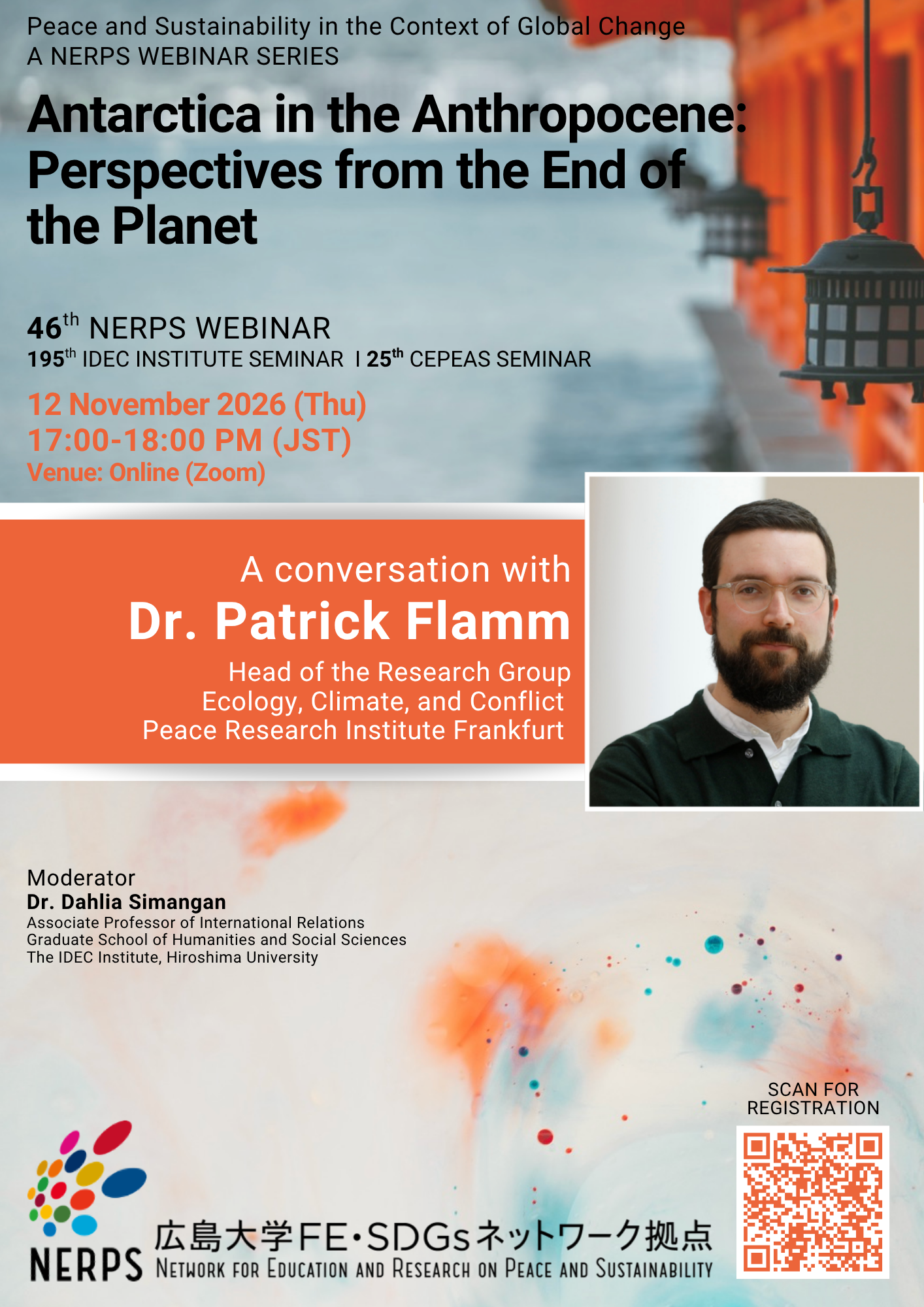
46th NERPS Webinar: Antarctica in the Anthropocene: Perspectives from the End of the Planet/ 第46回 NERPS ウェビナー:「人新世における南極:地球の果てからの視点」 2026/11/10
46th NERPS Webinar: Antarctica in the Anthropocene: Perspectives from the End of the Planet
November 12, 2026 (Thursday, 17:00 -18:00 PM JST)
ONLINE (Zoom)
ONLINE (Zoom)
About the Webinar
Antarctica occupies a unique position in the Anthropocene: it is a historically uninhabited continent simultaneously constructed as pristine laboratory, fragile victim, and global threat. The lecture examines Antarctica as a lab, conduit, and harbinger of planetary environmental change from the past into the future. As a laboratory, Antarctica is central to understanding Earth’s past and future. Ice cores extracted from its interior reveal deep environmental history, while the continent hosts extensive scientific monitoring of atmospheric chemistry and ecological change. Yet this epistemic framing creates tension between knowledge production and stewardship: proliferating research stations and logistics networks increase the human footprint in one of Earth’s last wildernesses. As a conduit, Antarctica functions as a planetary engine. The Antarctic Ice Sheet holds the majority of Earth’s fresh water, while the Southern Ocean absorbs vast amounts of heat and carbon dioxide. Warming ocean currents are ominously destabilizing glaciers at the continent’s edges, presaging sea-level rise threatening coastal populations worldwide.
Resource interests such as fishing and potential mineral extraction expose the continent to extractive pressures. As a harbinger, Antarctica signals where global governance succeeds and fails. The Antarctic Treaty System has maintained a demilitarized, nuclear-free continent devoted to peace and science for over 65 years, yet Antarctic exceptionalism is increasingly pressured by great power politics. The system’s environmental stewardship claim is eroded by its inability to grant special protection to the emperor penguin, an icon of climate vulnerability, while tourism surged to over 120,000 visitors per season without a legally binding regulatory framework. This is exacerbated by the “paradox of Antarctic environmental protection”: Antarctica must be protected outside Antarctica, through reduced carbon emissions globally. The lecture concludes by discussing potential future pathways of Antarctic governance in and for the Anthropocene.
About the Speaker
Dr. Patrick Flamm is Head of the Research Group Ecology, Climate, and Conflict and Senior Researcher at PRIF in the Research Department International Security. His research focuses on the relationship between the environment, peace and security in the “Anthropocene” as well as on polar geopolitics. He holds a PhD in Asian Studies from the University of Auckland and previously was a senior lecturer in International Relations at Te Herenga Waka – Victoria University of Wellington in Aotearoa New Zealand.
Contact
広島大学FE・SDGsネットワーク拠点(NERPS)
佐藤雅俊/西川由美/伊藤香
082-424-7640
nerps@hiroshima-u.ac.jp
佐藤雅俊/西川由美/伊藤香
082-424-7640
nerps@hiroshima-u.ac.jp
 前へ

 もみじ [もっと、身近な、情報システム]< 編集 > 広島大学教育室